Loading...
Serving Rocky Hill, CT and surrounding areas. (860) 730-0845
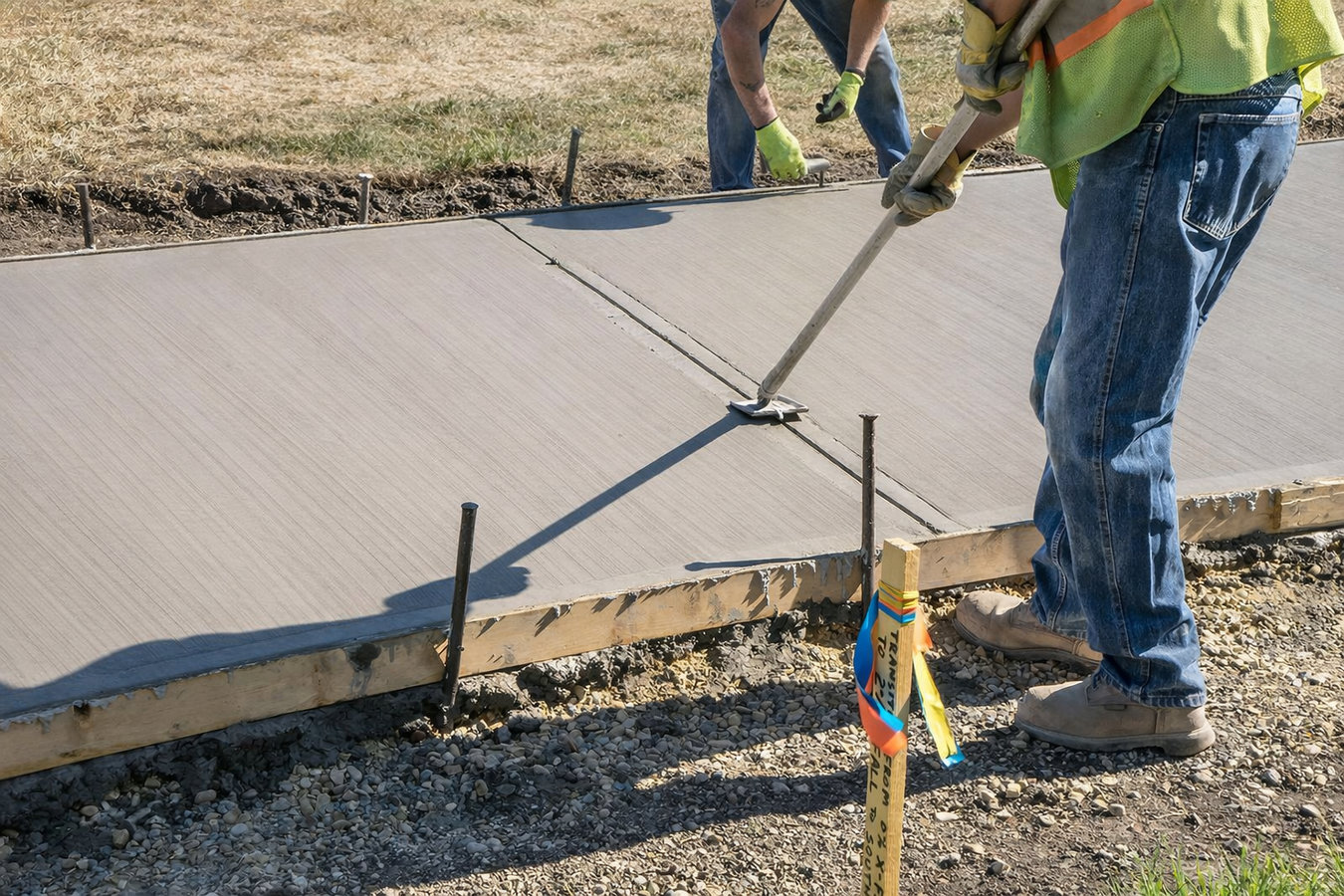
A cracked or uneven sidewalk is a hazard and an eyesore. We replace old walkways with properly poured concrete that holds up through Connecticut winters year after year.
Concrete sidewalk building in Rocky Hill involves removing whatever is there now, preparing a compacted gravel base, and pouring fresh concrete to a four-inch thickness - most residential walkway replacements take one day of active work, plus 24 to 48 hours before you can walk on the surface.
Many Rocky Hill homes were built in the 1950s through the 1980s, and a large share of those original sidewalks are now 40 to 60 years old. Concrete from that era was often poured thinner and without the base preparation that keeps slabs level through freeze-thaw cycles. If your walkway is heaving, cracking, or starting to crumble, the problem typically gets worse each winter rather than staying stable.
If you are also thinking about your driveway, our concrete driveway building service can replace or add a new driveway in the same project window - combining work reduces mobilization costs and keeps disruption to one stretch of time.
If you can feel a bump or a drop when you walk across your sidewalk, the slabs have shifted from frost heave, root growth, or soil movement underneath. In Rocky Hill's freeze-thaw climate, this kind of movement is common in older sidewalks and gets worse each winter. A raised edge of even half an inch is a tripping hazard and a sign the base is no longer doing its job.
Hairline cracks are normal in concrete and usually not a concern. But when a crack is wide enough to fit a pencil tip - or when one side sits higher than the other - the slab has moved and structural integrity is compromised. In Rocky Hill homes built before 1985, this kind of cracking often shows up in sidewalks poured without adequate control joints or base preparation.
If the top layer of your sidewalk looks like it is peeling away in thin chips or has a rough, pitted texture, the surface has been damaged - often by years of deicing salt or repeated freeze-thaw cycles. This is called spalling, and once it starts, it tends to spread. Patching will only delay the inevitable at that point.
A properly graded sidewalk sheds water away from your home toward the street or a drainage area. If puddles sit on the surface or water collects along the edge closest to your foundation, the slab has settled or was never graded correctly. Standing water accelerates freeze-thaw damage and can eventually work its way toward your foundation.
We handle the full scope of a sidewalk replacement - demolition and haul-away of old concrete, grading and compacting a stable base, setting forms, pouring to the correct thickness, finishing the surface, and placing control joints at proper intervals. A broom finish is standard for sidewalks because it gives you reliable traction in wet or icy conditions, which matters in a Rocky Hill winter.
Sidewalk work often happens alongside other projects. Our garage floor concrete service is a common pairing when the driveway apron and interior floor both need attention. If your walkway connects to steps at the front door, we can also handle those through our concrete driveway building and related flatwork services.
Best for walkways that are heaving, cracking, or simply at the end of their lifespan - demolition, new base, new pour.
Suits homes that do not yet have a proper concrete path from the driveway or street to the front door.
For homeowners who want the walkway to complement stamped concrete work elsewhere on the property.
For sidewalks that sit in the town's right-of-way along the street - we handle permit coordination with Rocky Hill's Public Works Department.
Rocky Hill sits in Hartford County, where temperatures regularly swing above and below freezing throughout the winter - sometimes multiple times in a single week. Every time water seeps into a small crack and then freezes, it expands and forces the crack wider. This means base preparation and surface sealing matter more here than in warmer climates. Connecticut's Department of Energy and Environmental Protection tracks climate data confirming Hartford County's demanding freeze-thaw cycle - and it is something every local concrete contractor should plan for from the first day of a job.
Rocky Hill's position in the Connecticut River Valley also means soils in many neighborhoods include silty or sandy deposits left by glacial Lake Hitchcock. These soils can shift or settle more than rocky upland soils found elsewhere in the state, which puts extra stress on concrete slabs over time. Homeowners in Cromwell face similar river valley conditions, and those in Newington deal with the same freeze-thaw pressures. A thorough base - compacted gravel at the right depth - is the first defense against sidewalk movement in all of these towns.
We respond within one business day and schedule a site visit - most contractors will not quote a sidewalk accurately from a photo alone. We measure the area, assess what needs to be removed, and ask about any finish preferences.
We check with Rocky Hill's Public Works Department if the sidewalk is near the street. Once any permits are in order, we agree on a start date. Concrete work is weather-dependent, so we build in flexibility for rain or cold days.
The crew breaks up and hauls away the old concrete, excavates to the right depth, adds and compacts a gravel base, and sets the forms. This is the noisiest part - expect jackhammer sound for a few hours.
Concrete is delivered and poured, the surface is finished with a broom texture, and control joints are cut at proper spacing. You can walk on it lightly within 24 to 48 hours, and vehicles should stay off for a full week.
No pressure. We'll come out, measure the job, and give you a written quote that includes demolition and haul-away - no hidden line items.
(860) 730-0845Many original sidewalks in Rocky Hill were poured thin, which is why they are failing now. We pour residential walkways to a standard four-inch thickness with proper base depth - the same spec recommended by the Portland Cement Association for residential concrete flatwork. That thickness gives you a surface strong enough to last decades, not years.
Sidewalks along the street require coordination with Rocky Hill's Public Works Department. We know this process and handle the permit and inspection coordination for you, so work is compliant from the start and you are not dealing with the town on your own.
Control joints cut across the slab every four to six feet give concrete a controlled place to relieve stress. Without them, cracks appear wherever the concrete decides to go. We cut joints at proper intervals on every pour, which is one of the biggest factors in a sidewalk that stays looking clean over time.
We leave the site the way we found it - no leftover concrete, no debris, no damage to surrounding grass or landscaping. You will not spend the weekend cleaning up after the crew. That is a basic standard we hold on every project in Rocky Hill and the surrounding towns.
Good sidewalk work is not complicated, but it requires attention to the details that prevent premature failure. We bring that consistency to every job in Rocky Hill, from the base depth to the final broom stroke.
Repair or replace your garage floor slab with a properly poured, finished concrete surface.
Learn MoreA full driveway replacement paired with your sidewalk project saves on mobilization and keeps disruption to a single stretch of time.
Learn MoreConcrete season in Connecticut fills up fast - reach out now to lock in your date before the summer schedule closes.